3 Future Tech Trends Spark Optimism
Ever wonder if tech breakthroughs could lead us to a brighter future? A new survey of IT pros shows that three trends, AI, quantum advances, and smarter cloud solutions, are sparking fresh ideas about how businesses run.
These trends are cutting downtime and making work environments run smoother. It’s like the busy hum of a sleek office is getting a much-needed upgrade.
In short, technology isn’t just about changing systems, it’s about lighting a path toward a smarter, more hopeful future.
3 future tech trends spark optimism

A recent survey of 1,000 U.S. IT pros shows that three tech trends are gaining major support. AI leads the pack, with 88% of experts saying it’s set to transform business. Think about it, tools like conversational AI and machine learning are already making systems smarter by automating tasks and significantly cutting downtime.
Quantum computing is creating an exciting buzz next. This technology can process countless possibilities all at once, which could lead to breakthroughs in areas like cryptography, material science, and financial analytics. Early testers in finance and pharmaceuticals are exploring how it might solve big problems, with many expecting it to really take off by 2027.
Cloud and edge computing round out the list. These advances are changing how data moves and is processed, making it possible for businesses to react in real time. For instance, digital twin projects have shown that merging cloud tech with machine learning can lead to notable revenue boosts.
For more details on these trends, check out articles on emerging technological trends and the latest technology outlook for a global view.
AI Advancements in Future Tech Trends

Neural networks are now smart enough to understand language almost like a person. This boost in capability makes real-time automation and personalized experiences possible. One study even showed a 25% rise in revenue when machine learning helped sort customers, while smart predictions cut downtime by 30%.
Imagine this: one company slashed production downtime by 30% in just one quarter using conversational AI. It’s a clear win for efficiency.
AI tools today can quickly use data to guide decisions, and thanks to natural language processing, conversations with machines feel surprisingly human.
- AI tools that make quick decisions from data
- Neural networks that grasp language like we do
- Predictive models that cut downtime by 30%
For more on the latest breakthroughs, check out the AI research headlines here: https://ServersFree.com?p=1852
Quantum Computing Breakthroughs in Future Tech Trends

Quantum processors work in a cool way. They use superposition, which lets quantum bits exist in many states at once. This means they can check millions of possibilities nearly at the same time, giving a boost of up to 100 times slower methods in areas like cryptography, material science, and financial analytics.
Experts believe that by 2027, we’ll start to see the real effects of quantum computing. Early users in finance, medicine, and even newer fields such as logistics and AI research are testing custom quantum solutions to cut processing times drastically. Imagine a quantum chip that turns months-long experiments into days. It’s a game changer for how we handle complex tasks.
This breakthrough not only speeds things up, it sets a fresh standard for future tech. For more details on how quantum computing is reshaping our world, see analysis of tech headline trends.
Robotics Innovations Shaping Future Tech Trends

Robots are getting smarter thanks to artificial intelligence that makes them interact more naturally with people. Whether it’s in logistics, healthcare, manufacturing, or everyday services, these upgrades are ready to change daily operations and boost user experiences. Experts say that by 2026, we’ll see trends like AI-powered cobots, delivery drones that fly by themselves, surgical robots with touch feedback, guided vehicles in warehouses, and service bots in hotels.
Take AI-driven cobots, for example. They’re designed to work right alongside humans in factories, making work faster and smoother. In hospitals, robots with touch sensors help surgeons perform with better precision. Warehouses will also see exciting changes as guided vehicles streamline how orders are filled, while delivery drones help get packages to your door in a snap. And looking ahead, self-driving vehicles could reach Level 4 autonomy by 2028, promising safer and more efficient travel.
| Application | Sector | Projected Adoption | Business Benefits |
|---|---|---|---|
| AI-driven cobots | Manufacturing | 2026 | Improved productivity and teamwork |
| Autonomous delivery drones | Logistics | 2026 | Faster order fulfillment and cost reduction |
| Surgical robots with haptic feedback | Healthcare | 2026 | Enhanced surgical precision and patient outcomes |
| Warehouse AGVs | Manufacturing/Logistics | 2026 | Streamlined operations and error reduction |
| Service bots in hospitality | Consumer Services | 2026 | Elevated customer engagement and service |
Blockchain Evolution within Future Tech Trends

Blockchain tech is slowly finding its footing, even though not everyone is on board. Sure, 37% of IT pros think it's overhyped, but real-world uses like tracking supply chains and handling cross-border payments show it can really work. Companies are now betting on practical, solid applications rather than just big promises, making blockchain a key tool for clear and secure transactions.
Central banks are also taking notice. Pilot programs for digital currencies are already running in 20 countries. This shows there's a rising interest in digital money, and traditional banks might soon jump on board to make everyday transactions smoother.
Decentralized finance platforms, or DeFi, are gaining serious traction too. User activity surged by 150% in 2024, proving that blockchain could change the way we handle money. Public and private ledgers are both evolving to meet different business needs, making solutions more efficient and scalable. As rules get clearer, expect more industries to embrace this technology in the coming years.
Immersive Technologies in Future Tech Trends
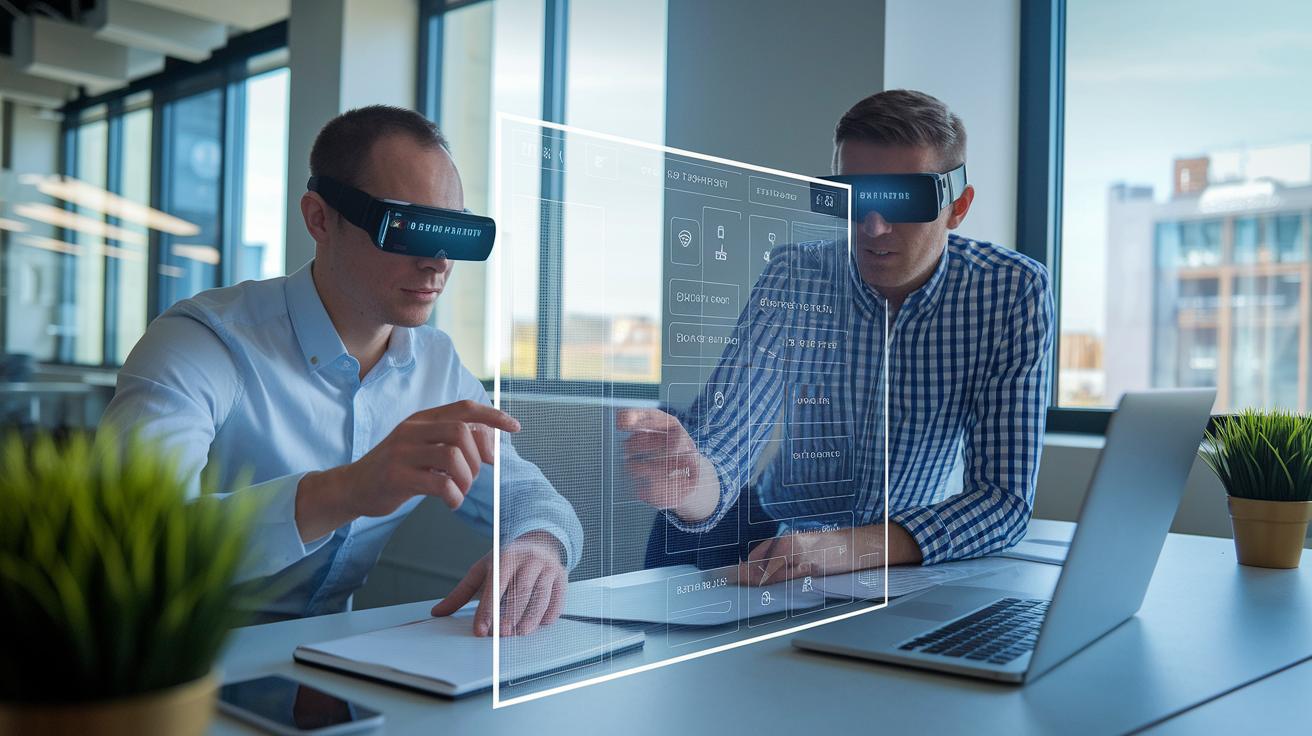
AR, VR, and MR are coming together in new, exciting ways that change how we work and have fun. Experts say nearly 500 million people could be enjoying these invisible experiences by 2028. Imagine walking into a space where the digital world and the real world blend perfectly. And here’s a cool fact: enterprise AR glasses used for remote help are already cutting error rates and boosting efficiency.
AR gives you remote support by overlaying important info right where you need it. That means experts can guide you without even being there. VR is shaking up training with simulations that boost how quickly skills are learned, up to 40% more effective, they say. Mixed reality is adding digital touches to everyday life, making both work and leisure more interactive and fun.
Here are four simple ways immersive tech is making a difference:
- Remote support: Real-time digital info makes difficult tasks easier.
- Training: VR simulations help people learn faster.
- Retail visualization: Virtual try-ons and 3D demos turn shopping into an adventure.
- Immersive entertainment: Digital landscapes mix creativity with play.
These innovations are opening new doors for solving problems and enhancing our daily experiences. Isn’t it amazing how tech keeps pushing boundaries?
Cybersecurity Developments in Future Tech Trends

A whopping 94% of survey takers say cybersecurity is still the top technical skill. New tools are stepping up to handle the challenges we face today.
For example, AI technology is now smart enough to spot odd patterns. This means it cuts down the time a breach hangs around by 60%. Imagine an AI tool that warns you of an attack before it really takes off. It’s becoming something we just can’t do without.
Zero-trust systems are making our setups tougher by not automatically trusting anyone or any device. Then there’s homomorphic encryption, which lets data stay locked while it’s still being used, a really cool extra layer of safety. Blockchain auditing adds clear, tamper-proof records so sensitive info is well-protected.
Privacy-enhancing computations work to keep personal details hidden even while the data is being worked on. New rules like GDPR 2.0 and expanded CCPA will soon force companies to use these smart, auto-made solutions.
- AI-based monitoring
- Zero-trust architectures
- Homomorphic encryption
- Blockchain auditing
- Privacy-enhancing computations
Putting these five tools together not only meets new regulations but also builds a solid defense against future cyber threats.
Sustainable Tech Initiatives in Future Tech Trends

Companies are embracing green tech to cut waste and keep costs low while giving back to our planet. Lately, businesses have seen that sustainable digital solutions can save money and make a real difference for the environment. Here are five real-world examples that highlight this trend:
- Smart energy management systems: Smart grids equipped with IoT sensors have reduced energy waste by 20%, making systems run smoother and cheaper.
- Solar and storage integrations: Combining solar panels with energy storage has halved costs since 2018, offering a cleaner and more affordable power option.
- Circular-economy platforms: Recycling platforms for electronics have grown by 35% in 2023, turning old devices into valuable resources and lightening the load on landfills.
- Carbon-capture ventures: Startups that capture carbon have pulled in $2 billion in venture capital, a sign that investors are backing new ways to cut harmful emissions.
- Renewable building automation: Digital tools for managing buildings now intelligently control heating, cooling, and lighting, saving energy and improving indoor air quality.
These examples show how blending smart tech with renewable energy strategies is reshaping industries. By adopting these innovative approaches, organizations not only boost their operational efficiency but also make a big, positive impact on our world.
Preparing for Future Tech Trends: Strategic Roadmap

Companies that want to stay ahead in technology need a clear and practical roadmap. Start by checking your current tech setup and skills, pick the projects that matter most, and keep a close eye on progress while measuring real benefits. Experts suggest updating your technology radar every few months to keep pace with rapid changes. And by continuously learning online, you can cover up to 70% of the emerging skills needed to keep your team sharp. Early tests with digital twin projects have even boosted process efficiency by 25%, a sign that scaling these efforts might pay off big.
- Assess current tech readiness: Look at your team’s skills and your digital tools to spot any gaps. For example, review your quarterly tech updates and see how your current systems match up with future needs.
- Prioritize pilot projects: Pick out specific technologies and projects that seem likely to make your operations run smoother.
- Establish robust governance: Set up clear guidelines and form dedicated teams to manage each change while continuously monitoring progress.
- Measure ROI: Define clear benchmarks and use data to ensure your improvements are turning into real growth and better efficiency.
Follow these four steps, and you’ll be well-prepared to navigate the fast-changing tech world and build a solid path to long-term success.
Final Words
In the action, the piece covered a range of insights on future tech trends. We touched on new moves in AI, quantum computing, and robotics, while also exploring blockchain, immersive technologies, and cybersecurity upgrades. The report reviewed how sustainable tech initiatives reshape industries and mapped out a clear strategy for tech investments. Every section aimed to provide practical details that you can use to shape your tech strategy. It’s exciting to see how future tech trends can inspire smart decisions and drive success.
FAQ
What are the top technology trends shaping our near future?
The question about top technology trends reveals that AI, quantum computing, robotics, and cloud computing are emerging as key players, with industry experts forecasting significant advances and widespread use through 2025–2026.
What do future tech trends worldwide and innovative technology ideas include?
The question about global future tech trends shows that advances like next-generation AI, immersive digital experiences, and sustainable tech solutions are set to transform industries, with impacts expected well into the mid-century.
What are the expected near-term tech trends for 2025?
The question regarding tech trends for 2025 underscores that breakthroughs in AI, digital twin technology, robotics, and immersive AR/VR are on track for rapid adoption, driving improved efficiencies and new business models.
How can organizations prepare for upcoming tech trends?
The question about preparing for future technology trends advises that companies update their tech radars regularly, invest in continuous employee learning, pilot emerging projects, and establish clear frameworks to measure performance and results.

Tech Breakthrough Sparks Industry Excitement

Assistive Technologies Spark Positive Change

Web3 Technology: Inspiring Decentralized Future
About The Author
